
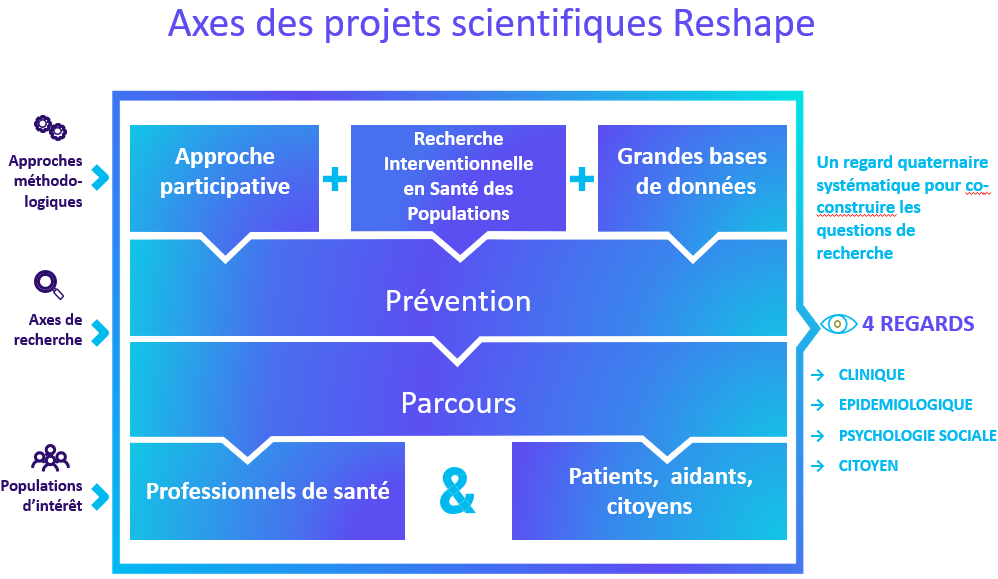
The laboratory has four themes (4 axes): participatory approaches, patient care and life course, primary prevention, health and student performance in health.
- Participatory Axis: group of patient partners who participate in research projects at all stages, from design and implementation to the interpretation of results and scientific validation. This axis can also support researchers in the development of qualitative methodologies. These approaches have been implemented to develop and evaluate pathway improvement programs that include new healthcare professions or new support systems for patients and caregivers. This axis is supported by: Dulce FERRAZ, Quitterie REYNAUD and Romaine DESJARDIN.
- Large Databases Axis: studies the impact of health policies on professional practices, patient pathways and health outcomes from large databases. This axis is supported by Marie VIPREY, Marc CHANELIERE and Anaïs HAVET.
- Interventional Research Axis: development and evaluation of new organizations aimed at improving the pathways and health of patients and healthcare system users as well as their ability to act (empowerment) in particular through participatory research and the consideration of health literacy. This axis is supported by Arnaud SIMEONE, Edouard LEAUNE and Marion DELVALLEE.
- Healthcare professionals axis: The research work in this axis focuses on one hand on bio-psycho-social and professional characteristics of caregivers and their links with the results of care in terms of quality and safety, and on the other hand to the impact of certain organizational methods on the health of caregivers and on the results of care. This axis is supported by Marc LILOT, Sophie SCHLATTER and Tanguy LEROY.
ligne

In order to investigate these themes, three methodological approaches, combining skills, expertise and equipment, support the work of the unit's researchers:
1 Mixed methods (quanti/quali) approaches :
Quantitative methods are absolutely necessary, but lack the depth to understand the processes leading to the observed results. They must be complemented by qualitative methods to identify the sometimes unforeseen determinants, and to study the processes that enable the implementation of interventions. Our research in this area uses methods from the sciences of implementation and evaluation of complex interventions, and allows for the co-construction and evaluation of the impact and implementation of innovative solutions.
2 Data warehouse analysis approaches :
Particularly useful for studying real-life health services, the use of local (EDS HCL) and national (PMSI-SNDS) data warehouses allows the study of health professionals' performance by considering their intrinsic and extrinsic determinants as well as patient adherence. The exploitation of data collected in the context of care allows us to constitute cohorts of professionals whose health data can be matched with those of their patients and ad hoc questionnaires.
3 Approaches in high-fidelity simulated environments :
Immersive simulated environments provide considerable opportunities for studying the human factors that modify the individual or team performance of health professionals. By mimicking clinical situations of varying complexity, simulation allows us to both observe the behavior of professionals and to test the effectiveness of learning techniques. It also allows the development of useful tools and cognitive aids for the management of critical situations that can then be tested in the field in the real world.